This page is for informational purposes only. Always verify result details from the official RCPath website before acting on any information.
Results DeclaredUpdated May 2026Spring 2026
FRCPath Part 1 Result 2026 Declared: Spring 2026 Results, Student Success & What to Do Next
The FRCPath Part 1 Histopathology and FRCPath Part 2 Histopathology Spring 2026 results were declared on Friday, May 22, 2026. This updated guide covers the confirmed result date, how to verify your result, what successful candidates are saying, and the practical next steps after the May 2026 result.
Understanding what the result means and who it's for.
The FRCPath Part 1 Result is the outcome of the Part 1 examination conducted by the Royal College of Pathologists (RCPath), United Kingdom. This examination is a summative assessment of a candidate's core theoretical knowledge in their chosen pathology specialty — testing whether they have acquired the foundational understanding needed to practise in that field.
The exam is relevant to candidates in over 20 pathology specialties, including Histopathology, Haematology, Clinical Biochemistry, Medical Microbiology & Virology, Infection, Immunology, Molecular Pathology, and more. The examination is held twice each year — in the Spring and Autumn sessions.
Candidates who sit the FRCPath Part 1 include UK-based trainees (typically from ST2 onwards), international medical graduates (IMGs) pursuing pathology careers, clinical scientists on the HSST pathway, and experienced pathologists from around the world seeking this internationally recognised qualification.
What candidates usually look for after result day
Whether they have passed or need to reattempt
Their individual performance feedback letter from RCPath
Official pass rates by specialty to understand their result in context
Guidance on next steps — either progressing to FRCPath Part 2 or planning a structured reattempt
Timeline for the next examination sitting if reattempting
2. FRCPath Part 1 Result Date & Exam Timeline 2026
Spring 2026 results are now declared, with the confirmed result date candidates were searching for.
Spring 2026 Session
For the Spring 2026 session, the FRCPath Part 1 examinations took place in the week commencing 23 March 2026, with Part 1 Histopathology held on Tuesday 24 March 2026 (afternoon) and other specialties across the examination period.
Confirmed Spring 2026 Result Date
Declared Friday, May 22, 2026
FRCPath Part 1 Histopathology and FRCPath Part 2 Histopathology candidates received their Spring 2026 outcomes on the declared May 2026 result date.
Spring 2026 result update: Results declared May 22, 2026. Candidates should still verify their individual outcome through the official RCPath result communication or candidate portal guidance.
How results are released
The method of result release has changed in recent sittings. Based on RCPath's official announcements and recent result-day process:
Part 1 results have recently been emailed directly to candidates rather than published on the website. In Autumn 2025, for example, RCPath confirmed that Part 1 results would be emailed to candidates by midday on results day and would not be published on the website.
Part 2 results continue to be published on the RCPath website by candidate number.
Spring 2026 results were declared on Friday, May 22, 2026, matching the published result-date timeline.
Detailed result letters are usually emailed to all candidates in the week following the results release.
Important: Confirm the exact release method for your sitting directly from the RCPath Examinations News page. The process may change between sittings. Do not rely on third-party sources for the exact method of result delivery.
Autumn 2026 Session (upcoming)
Autumn 2026 is especially important because RCPath has confirmed that the Autumn 2026 session will be the last sitting in the current examination format, with a new format commencing from Spring 2027. Applications for the Autumn 2026 examination session will open by 5pm on Friday, 29 May 2026 and close on Friday, 3 July 2026. Candidates planning a first attempt or reattempt should check the official RCPath calendar and begin preparation early.
Application window: opens by 5pm on Friday, 29 May 2026 and closes Friday, 3 July 2026.
Withdrawal deadline: Friday, 17 July 2026 for a full refund of the fee without extenuating circumstances. This deadline does not apply in circumstances beyond your control, such as illness or travel restrictions.
Reasonable Adjustments: requests should also be made no later than Friday, 17 July 2026.
Entry confirmation: examination entries will be confirmed by 5pm on Friday, 31 July 2026.
Examination period: Monday, 21 September to Friday, 30 October 2026, with Part 1 examinations taking place in the first week of the period.
Results date: Friday, 20 November 2026.
Session
Exam Period
Results Date
Status
Spring 2026
23 Mar – 1 May 2026
22 May 2026
Results declared
Autumn 2026
21 Sep – 30 Oct 2026
20 Nov 2026
Applications open 29 May and close 3 Jul 2026; last sitting in current format
Step-by-step guide for candidates checking the Spring 2026 result.
The FRCPath Spring 2026 result has now been declared. If you sat FRCPath Part 1 Histopathology or are checking the FRCPath result May 2026 update, use the official RCPath communication as the final source for your individual result.
1
Check the official RCPath result communication
Visit the RCPath Examination Results page and check the email address registered with your RCPath application for official result communication.
2
Keep your candidate number ready
Your candidate number is included in the confirmation of entry email sent by RCPath after your application was accepted. If you cannot find it, check your original application confirmation.
3
Review the email sent on or after May 22, 2026
In recent sittings, Part 1 results have been emailed directly. Check your registered email, including spam and junk folders, for the Spring 2026 result communication.
4
If results are published online
Visit the RCPath Results page. Results are displayed by candidate number only. The page may be busy immediately after release — if so, wait 15–30 minutes and try again.
5
Wait for your detailed results letter
A detailed performance letter is typically emailed to all candidates in the week following results release. This letter contains a breakdown of your performance across different areas of the examination.
Do not telephone the Examinations department. RCPath explicitly states that College staff are not permitted, in any circumstances, to discuss or give out examination results by telephone or email. Please wait for the official release.
For UK trainees: deanery notification
Each deanery receives a list of their RCPath-registered trainees who sat the examination, along with results. This is to ensure deaneries can provide early support to trainees who do not pass. If you are a UK trainee, your training programme director will typically be informed of your result on the same day.
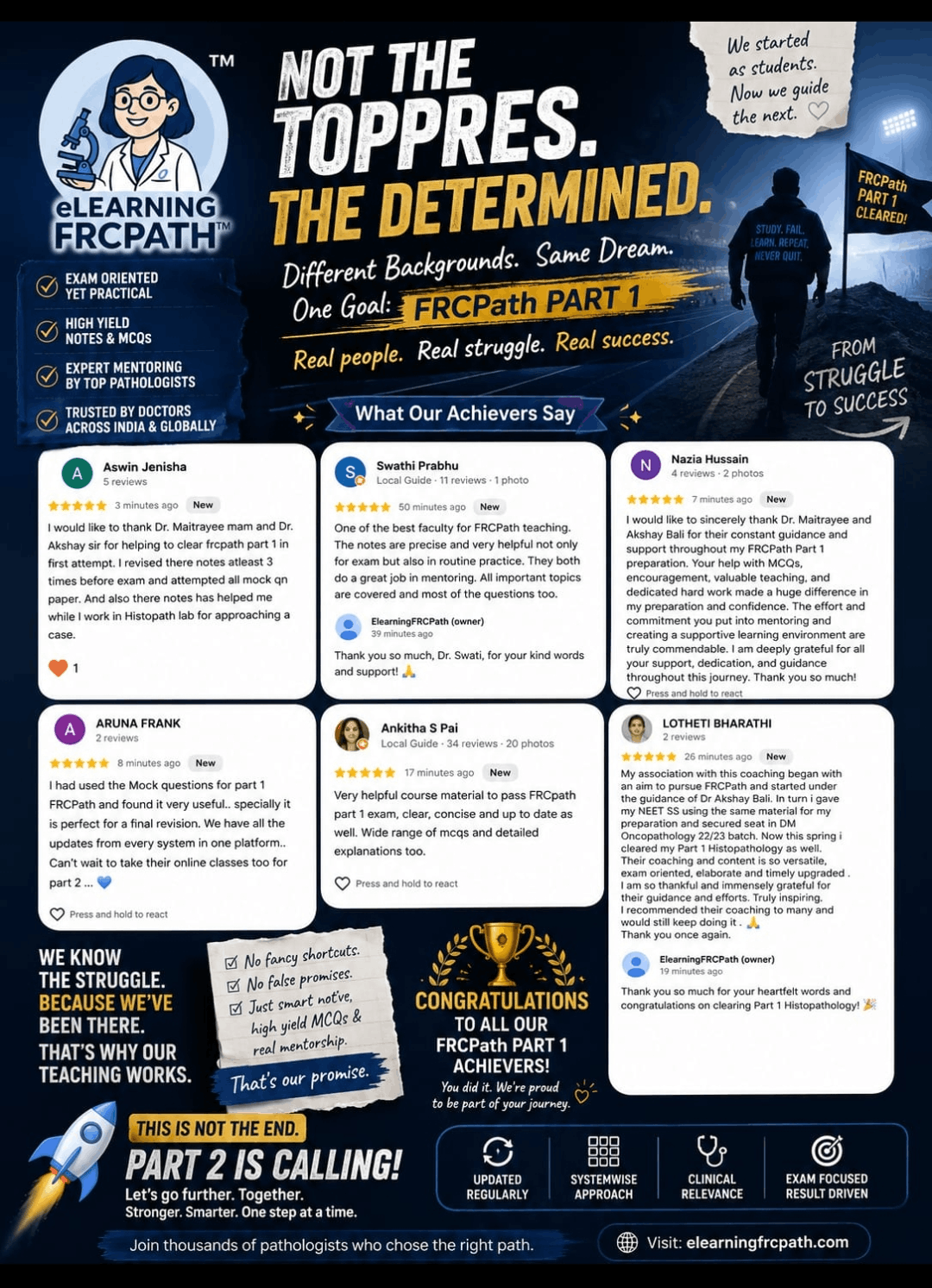
Congratulations to Our Students
Spring 2026 success stories from FRCPath Part 1 and Part 2 candidates.
We are delighted to congratulate our students who cleared the FRCPath Histopathology Spring 2026 examination cycle. Several students shared that the structured classes, high-yield notes, MCQs, and mock papers helped them stay focused through the final stretch before the May 22, 2026 result.
★★★★★
"I've cleared my FRCPath Part 1 under the guidance of Dr. Akshay Bali Sir. His way of teaching is out of the box, and he manages to teach high-impact points concisely and logically."
Swati Rathore
FRCPath Part 1
First-attempt passer
★★★★★
"Highly recommend the eLearning FRCPath classes by Dr. Maitrayee Roy and Dr. Akshay Bali. Their clear conceptual teaching, high-yield discussions, and exam-oriented guidance were extremely helpful."
Priya Pawar
FRCPath Histopathology Part 1
First-attempt passer
★★★★★
"I have cleared FRCPath Part 1 in my first attempt and this couldn't have been possible without the excellent guidance of Dr. Maitrayee ma'am and Dr. Akshay sir."
Oindrila Das
India · FRCPath Part 1
First-attempt passer
★★★★★
"I revised their notes at least three times before the exam and attempted all mock question papers. Their notes also helped me while working in the histopathology lab."
Aswin Jenisha
FRCPath Part 1
★★★★★
"I have cleared the FRCPath Part 1 examination, and this achievement would not have been possible without the exceptional guidance and support from Dr. Maitrayee ma'am and Dr. Bali Sir."
Dr Prannoy Das
India · FRCPath Part 1
★★★★★
"The classes and notes were highly relevant to the exam, and almost every topic encountered in the paper had been covered during the sessions. Highly recommended for anyone planning to take FRCPath."
Nidhi
India · FRCPath Part 1
★★★★★
"I'm delighted to share that I have cleared the FRCPath Part 2 Spring 2026 on my first attempt. Your notes and teaching style were invaluable - they truly served as the backbone of my preparation and gave me the confidence to approach the exam effectively."
Neha Shaikh
FRCPath Part 2 · Spring 2026
First-attempt passer
★★★★★
"I cleared the Spring 2026 Part 2 Histopathology exam in my first attempt. I cannot thank you enough for your course material and classes. Dr Maitrayee, your voice is one even my son recognises in his sleep!"
Dr Priya
FRCPath Part 2 Histopathology · Spring 2026
First-attempt passer
★★★★★
"I cleared the exam. Thank you for all your support, for clearing my doubts, and for your videos. The long cases are the best and up to date."
Nahla Omar
FRCPath Part 2
★★★★★
"Mam, I have cleared with God's grace. Thank you for your support and guidance."
Sruthi P
FRCPath Part 2
★★★★★
"I passed my Part 2 exam. Thanks for mentoring. Couldn't have done it without your assistance."
Aiman Raza
FRCPath Part 2
★★★★★
"Thank you for providing so much knowledge with up-to-date recent advances and huge study material at low cost. I passed the Part 2 exam. Thank you for your invaluable guidance."
S Shital Gosavi
FRCPath Part 2 · Autumn 2025
★★★★★
"I cleared my FRCPath exam. You have truly been an integral part of this journey. Without your course, I can't imagine how I would have prepared for this entire process. Thank you for the encouragement, guidance, and incredible study material."
Download and preserve your result confirmation and future RCPath correspondence.
Discuss credentialing, GMC, consultant-pathway, or local career progression steps with your supervisor.
Document your training evidence while the exam preparation period is still fresh.
If You Did Not Pass
Wait for the detailed performance letter before changing your study plan.
List weak domains and rebuild preparation around MCQs, timed mocks, and active recall.
Plan early for Autumn 2026, the final sitting in the current examination format.
If You Are Preparing for Autumn 2026
Start now with a structured timetable rather than waiting for the Friday, 3 July 2026 application deadline.
Use high-yield notes, concept videos, and mock tests in repeated revision cycles.
Prioritise WHO 5th edition updates, RCPath datasets, IHC, molecular markers, and exam-pattern MCQs.
Result-day momentum matters: Whether you passed or are planning a reattempt, the week after the Spring 2026 result is the best time to decide your next exam plan while your preparation strengths and gaps are still clear. If you're gearing up for Autumn 2026, explore the FRCPath Part 1 course.
4. FRCPath Part 1 Passing Percentage & Official Performance Data
What the official data tells us — and what it doesn't.
The Royal College of Pathologists publishes Examination Performance Reports after each sitting. These reports provide the overall pass rate and, where candidate numbers allow (minimum six candidates per specialty), a breakdown by specialty.
Most recently published data: Spring 2025
The most recently available official performance report (Spring 2025) shows:
Source: RCPath Examination Performance Report, Spring 2025, Part 1. Note: Data is only published for specialties with 6+ candidates to protect anonymity.
What this means for you
An overall pass rate of approximately 70% means that roughly 3 in 10 candidates do not pass on a given attempt. This is a competitive examination, and pass rates vary by specialty. Histopathology — the specialty most relevant to eLearningFRCPath's core course — has historically had pass rates in the 60–70% range, making structured preparation essential.
Spring 2026 pass rates will not be available until RCPath publishes the corresponding performance report, typically several weeks after results are released. When available, they will be published on the RCPath Performance Reports page.
5. FRCPath Part 1 Cutoffs & Scoring
What is publicly known about passing thresholds.
The Royal College of Pathologists does not publicly disclose specific cutoff marks or numerical passing scores for the FRCPath Part 1 examination. The examination is not scored on a simple percentage-correct basis.
What candidates should understand
Standard setting: RCPath uses established psychometric methods to determine the passing standard. This means the pass mark is set based on the difficulty of the questions and expected competence level, not a fixed percentage.
No published cutoff score: You will not find a specific "passing mark" (such as 60% or 65%) published by RCPath. If any third-party source claims a specific cutoff, treat it with caution — it is not officially verified.
Result is pass/fail: Candidates receive a pass or fail outcome. The detailed performance letter provides information about performance across different areas, but not a numerical total score.
Maximum of four attempts: Candidates are allowed a maximum of four attempts at Part 1. After four unsuccessful attempts, candidates must apply to the Mitigating Circumstances Panel if they wish to attempt the examination again.
Do not rely on unofficial cutoff figures. Any specific passing marks or cutoff percentages circulated in study groups, forums, or social media are not verified by RCPath and should not be used for preparation planning.
6. Regional Performance & Global Candidates
What's known about UK vs international candidate performance.
The RCPath Examination Performance Reports do provide some data broken down by UK and international centres and by attempt number. However, the College does not publish a country-by-country breakdown of pass rates.
What the official reports tell us
Performance data is sometimes broken down into "UK centres" vs "international centres."
Historically, there has been a documented gap between UK and overseas pass rates, as noted in official RCPath performance reports.
First-attempt candidates typically have higher pass rates than those on subsequent attempts.
Why performance varies — it's about preparation, not geography
The gap in performance between UK and international candidates is primarily attributed to differences in:
Access to structured training: UK trainees typically benefit from supervised specialty training programmes with exam-aligned curricula, departmental teaching, and educational supervisor support.
Familiarity with UK examination style: RCPath exams follow specific formats and test patterns that may differ from examinations in other countries. Candidates unfamiliar with UK-style questions may find the format challenging regardless of their clinical knowledge.
Availability of preparation resources: Access to structured courses, mock examinations, and peer study groups varies significantly. This is precisely the gap that platforms like eLearningFRCPath aim to bridge for international candidates.
Alignment with UK guidelines: RCPath expects answers to align with UK clinical practice, UK guidelines (e.g., NICE, RCPath datasets), and UK-relevant classifications (WHO 5th Edition). International candidates must invest time in understanding these UK-specific standards.
FRCPath candidates come from across the globe — India, Pakistan, Egypt, Nigeria, Saudi Arabia, the UAE, Southeast Asia, Australia, and many other countries. Success is not determined by where you sit the examination, but by how systematically you prepare for it.
7. What to Do After FRCPath Part 1 Result Declaration
Your practical next-step checklist, whether you passed or not.
If You Passed
Celebrate — you've earned a significant milestone
Wait for your official results letter with performance details
Inform your educational supervisor and training programme director
For UK trainees: Your deanery will be informed of your result. Deaneries are expected to provide early support to trainees who do not pass. If you are struggling, reach out to your educational supervisor — they are there to help.
8. Career Opportunities After Passing FRCPath Part 1
What passing Part 1 opens up for your career.
Passing FRCPath Part 1 is a significant milestone, but it is not an endpoint. It is the first of two major examinations on the path to Fellowship of the Royal College of Pathologists. Here is what it means for your career:
For UK trainees
Training progression: Passing Part 1 is typically expected by ST5 and is essential for progression through higher specialty training.
Part 2 eligibility: You become eligible to sit the FRCPath Part 2 examination after the required period of further training (usually at least 12 months after passing Part 1, and a minimum of 2.5 years of specialty training for Part 2).
CCT pathway: Successful completion of both Part 1 and Part 2 is mandatory for the Certificate of Completion of Training (CCT) in your pathology specialty.
For international candidates
Credential enhancement: FRCPath Part 1 is internationally recognised and demonstrates competence in core pathology knowledge to employers worldwide.
GMC registration pathway: FRCPath (both parts) is an accepted qualification for overseas doctors seeking full GMC registration with a licence to practise in the UK, offering an alternative to routes like PLAB or MRCP.
Competitive advantage: In countries like India, Pakistan, Egypt, and the Gulf states, holding FRCPath provides a significant competitive advantage for senior positions, particularly in academic and tertiary care settings.
Career mobility: The qualification is recognised across the UK, Ireland, Gulf states, parts of Africa, and Australasia.
Pathology subspecialties accessible through FRCPath
The FRCPath examination is offered across more than 20 specialties. Passing Part 1 in your chosen specialty — whether that's Histopathology, Haematology, Clinical Biochemistry, Microbiology, or another field — opens the door to consultant-level practice in that subspecialty.
9. Benefits of Passing FRCPath Part 1
What you gain beyond the result letter.
Professional credibility: Demonstrates to colleagues, employers, and institutions that you have a verified core knowledge base in your pathology specialty, assessed to a UK standard.
Progression toward specialisation: Part 1 is the gateway to Part 2, which in turn leads to Fellowship — the highest professional qualification awarded by the Royal College of Pathologists.
Exam confidence: Having passed a rigorous, internationally benchmarked examination builds confidence in your clinical reasoning and theoretical foundations. This confidence carries into daily clinical work.
Clinical growth: The preparation process itself — systematic study of pathology, molecular markers, classifications, and guidelines — deepens your understanding of the specialty in ways that directly benefit patient care.
Network and community: Engaging with the RCPath examination process connects you with the broader UK and international pathology community, opening opportunities for mentorship, collaboration, and professional development.
Foundation for further examinations: The study habits, knowledge base, and exam technique you develop for Part 1 form the foundation for Part 2 and for lifelong professional learning through CPD.
10. If You Don't Pass — What It Means and What to Do
Practical, honest guidance for candidates who need to reattempt.
Not passing FRCPath Part 1 is more common than many candidates realise. With an overall pass rate of approximately 70%, around 200 of the 659 candidates in the Spring 2025 sitting did not pass. You are not alone, and a single unsuccessful attempt does not define your career.
What it means practically
You are permitted a maximum of four attempts at Part 1.
You will receive a detailed performance letter from RCPath, which provides information about your performance across different sections of the examination. This letter is your most valuable tool for planning your next attempt.
If you are a UK trainee, your deanery will be informed, and you should be offered support from your educational supervisor.
If you are resitting following an unsuccessful attempt, you typically do not need to reapply online for the next session — you can notify the Exams team in writing. Check the RCPath application page for the specific process.
How to review your performance
Read your performance letter carefully. Identify which areas you performed well in and which areas were weak. This is not a time for general impressions — be specific.
Map weak areas to the syllabus. Download the official RCPath curriculum for your specialty and identify which curriculum domains correspond to your weaker areas.
Assess your preparation method. Did you rely too heavily on reading without active recall? Did you practise enough under timed conditions? Did you study UK-specific guidelines and classifications? Honest self-assessment is essential.
Remember: Every year, candidates who failed their first or second attempt go on to pass subsequently with better preparation. A structured, focused reattempt plan significantly improves your chances. The key is to treat the performance letter as a roadmap, not a verdict.
11. Best Strategy for the Next FRCPath Part 1 Attempt
A structured approach for first-time and reattempting candidates.
Whether you're preparing for your first attempt or planning a reattempt after an unsuccessful sitting, the principles of effective preparation are the same — but the emphasis shifts based on your experience.
Step 1: Start with the official syllabus
Download the latest curriculum document for your specialty from the RCPath Examinations by Specialty page. This is the definitive guide to what can be examined. Every topic you study should map back to this document.
Step 2: Identify weak areas (reattempting candidates)
If you're reattempting, your performance letter from the previous attempt is your starting point. Focus disproportionate time on weak areas while maintaining your strengths through periodic revision.
Step 3: Build a timetable with revision cycles
For Histopathology, a minimum of 3 months' dedicated preparation is recommended for UK trainees and 6–12 months for international candidates. Structure your timetable to include:
First pass (weeks 1–8): Systematic coverage of all curriculum areas, making concise notes.
Second pass (weeks 9–14): Active recall, question practice, and deepening weak areas.
Third pass (weeks 15–18): Timed mock examinations, rapid revision, and IHC/molecular marker consolidation.
Step 4: Practise with exam-pattern questions
FRCPath Part 1 uses specific question formats (EMQs, SBAs, BOFs depending on specialty). Practising with questions that match the exam format is essential. Aim for at least 1,000 practice questions before your exam, with detailed review of explanations for both correct and incorrect answers. Resources like the eLearningFRCPath 800+ MCQ bank are designed for exactly this purpose.
Step 5: Align with UK guidelines and classifications
This is where many international candidates lose marks. Ensure your preparation covers:
WHO Classification of Tumours, 5th Edition (current standard)
Part 1 examinations typically consist of 125 questions in 180 minutes (format varies by specialty). That gives you approximately 1 minute 26 seconds per question. Practise under strict timed conditions well before exam day.
Step 7: Join a study group or preparation course
Candidates who study in a structured environment — whether a formal course or a peer study group — consistently report feeling better prepared. If you're an international candidate without access to a UK training programme's teaching, a dedicated FRCPath preparation course can provide the structure, expert guidance, and practice material you need.
Prepare With Confidence — eLearningFRCPath Resources
Designed by practising pathologists for candidates who want structured, exam-focused preparation.
FRCPath Part 1 Course
Comprehensive Histopathology preparation with WHO 5th Ed. aligned content.
800+ Mock Test MCQs
Exam-pattern questions with detailed explanations for every answer.
High-Yield Notes
System-by-system notes covering all major curriculum areas.
Live Sessions
Weekly interactive sessions with Dr. Akshay Bali.
Whether you're preparing for your first attempt or building a focused reattempt plan, these resources are built to give you exam-relevant clarity — not textbook overload.
When was the FRCPath Part 1 Spring 2026 result declared?
The FRCPath Part 1 Spring 2026 result was declared on Friday, May 22, 2026. FRCPath Part 1 Histopathology and FRCPath Part 2 Histopathology candidates should verify their individual outcome through the official RCPath result communication.
Will Part 1 results be published on the RCPath website or emailed?
In recent sittings, Part 1 results have been emailed directly to candidates rather than published on the website. The method may vary between sittings, so always check the official RCPath announcements and your registered email account.
What is the FRCPath Part 1 pass rate?
The most recently published data (Spring 2025) shows an overall Part 1 pass rate of 70.11%. Pass rates vary by specialty — for example, Histopathology had a pass rate of 67.17% in that session. RCPath publishes performance reports after each sitting on their website.
Is there a specific cutoff mark or passing score for FRCPath Part 1?
No. RCPath does not publicly disclose a specific cutoff mark or numerical passing score. The pass/fail standard is set using established psychometric methods. Any cutoff figures circulated online are unofficial and should not be relied upon.
How many times can I attempt FRCPath Part 1?
Candidates are permitted a maximum of four attempts at Part 1. After four unsuccessful attempts, candidates must apply to the Mitigating Circumstances Panel and Director of Examinations if they wish to attempt the examination again. This is not guaranteed and requires further training and justification.
Do I get detailed feedback if I don't pass?
Yes. RCPath provides each candidate with a detailed performance letter that assesses their knowledge based on the examination. This letter indicates strengths and weaknesses across different areas and should be used to guide preparation for a reattempt.
Do I need to reapply online if I'm resitting after a failed attempt?
In recent sessions, RCPath has stated that Part 1 candidates resitting following the previous session do not need to apply online. They should notify the Exams team in writing at the examinations email address by the application closing deadline. Verify the current process from the RCPath application page.
When can I sit FRCPath Part 2 after passing Part 1?
RCPath recommends waiting at least 12 months after passing Part 1 before attempting Part 2. Additionally, you must have completed the required period of specialty training (typically at least 2.5 years for medically qualified candidates). Check the specific requirements for your specialty on the RCPath website.
Is the Autumn 2026 sitting the last in the current exam format?
Yes. RCPath has confirmed that the Autumn 2026 sitting will be the last sitting of the current format examination. Applications open by 5pm on Friday, 29 May 2026 and close on Friday, 3 July 2026. The examination period runs from Monday, 21 September to Friday, 30 October 2026, with results due on Friday, 20 November 2026.
What should I do after passing the FRCPath Part 1 May 2026 result?
Save your official result communication, wait for the detailed performance letter, inform your supervisor if relevant, and begin planning your FRCPath Part 2 pathway. RCPath generally recommends waiting at least 12 months before attempting Part 2.
Can international candidates sit FRCPath Part 1 in their home country?
For the Spring 2026 session, RCPath conducted Part 1 examinations online but in examination centres with in-person invigilation. The aim for Autumn 2026 is to deliver examinations in test centres with invigilators both in the UK and internationally, with increased international centres being explored. Check the official RCPath examination news for confirmed arrangements for your session.
How long should I prepare for FRCPath Part 1?
Preparation time depends on your background. UK trainees with ongoing departmental training typically need a minimum of 3 months of focused preparation. International candidates or those without regular UK-style exposure are generally advised to prepare for 6–12 months. Quality of preparation matters more than duration — structured courses with mock exams significantly improve efficiency.
Does FRCPath help with GMC registration?
Yes. FRCPath (both Part 1 and Part 2) is an accepted qualification for overseas doctors seeking full GMC registration with a licence to practise in the UK. It provides an alternative pathway to registration without needing PLAB or MRCP, and is particularly valued for pathology specialist positions.
14. Official Guidance & Disclaimer
This page is informational — always verify with official sources.
Important: This page is published by eLearningFRCPath for informational and educational purposes only. While every effort has been made to ensure accuracy using official RCPath sources, examination regulations, result dates, and procedures may change without notice. Always verify result-related information directly from the Royal College of Pathologists before taking any action.
eLearningFRCPath is not affiliated with, endorsed by, or officially associated with the Royal College of Pathologists. The RCPath name, logo, and all examination-related trademarks belong to the Royal College of Pathologists.
Ready to prepare for your next FRCPath Part 1 attempt?
Structured courses, 800+ MCQs, and expert guidance — designed for candidates who want to pass.